


Total test – 47
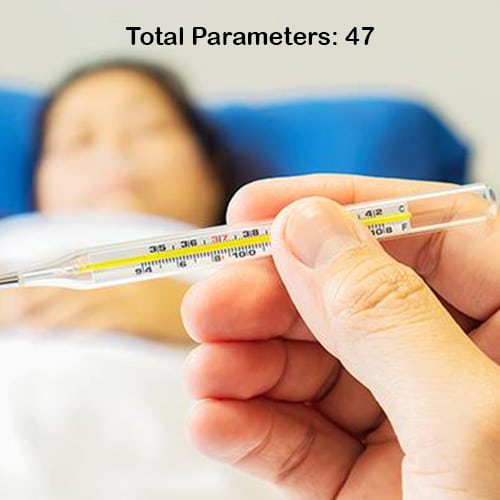
The fever profile comprises tests that help in detecting the cause of fever.
It includes
Alanine transaminase (ALT).
ALT is an enzyme found in the liver that helps convert proteins into energy for the liver cells. When the liver is damaged, ALT is released into the bloodstream and levels increase.
Aspartate transaminase (AST).
AST is an enzyme that helps metabolize amino acids. Like ALT, AST is normally present in blood at low levels. An increase in AST levels may indicate liver damage, disease, or muscle damage.
Complete urine examination (15 parameters)
This test is useful in the evaluation of conditions such as urinary tract infection (UTI), dehydration, and kidney stones. It detects abnormalities of urine and urinary tract infection (UTI); diagnoses and manages renal diseases, urinary tract infection, urinary tract neoplasms, systemic diseases, and inflammatory or neoplastic diseases adjacent to the urinary tract.
Complete blood count (CBC) (22 parameters )
A complete blood count, or CBC, is a blood test that measures many different parts and features of your blood, including
Red blood cells, which carry oxygen from your lungs to the rest of your body.
White blood cells, which fight infections and other diseases. There are five major types of white blood cells. A CBC test measures the total number of white cells in your blood. A different test called a CBC with differential measures the number of each type of these white blood cells.
Platelets, which stop bleeding by helping your blood to clot.
Hemoglobin, a protein in red blood cells that carries oxygen from your lungs to the rest of your body.
Hematocrit, a measurement of how much of your blood is made up of red blood cells.
Mean corpuscular volume (MCV), a measure of the average size of your red blood cells.
Erythrocyte sedimentation rate (ESR)
If your doctor suspects high levels of inflammation in the body, they may recommend a blood test called an erythrocyte sedimentation rate (ESR) test. It looks at how quickly red blood cells may sink to the bottom of a test tube, with a high rate of settlement indicating high inflammation.
Malarial antigen (Vivax and Falciparum)
A malaria antigen test is a rapid diagnostic test (RDT) that employs immunochromatographic methods in order to detect malarial antigens (proteins) in your peripheral blood. This helps in confirming the presence of the malaria parasite in your blood, and aids in arriving at a diagnosis of malaria.
Peripheral smear. (4 parameters)
A peripheral blood smear (PBS) test is a technique healthcare providers use to examine your red and white blood cells and your platelets under a microscope.
A peripheral blood smear test shows how your blood cells and platelets look under a microscope. Looking through a microscope for
- Changes in your blood cell and platelet size and shape may be a sign of a blood disorder or blood cancer.
- Changes in the number or count of your blood cells and platelets. Changes in blood cell and platelet countmay be a sign something is happening in your bone marrow, which produces blood cells and platelets.
- Abnormal changes in any of your different white blood cell types.
- Signs you may have parasites in your blood.
Typhoid IgM test
Typhoid fever caused by Salmonella typhi . It is a blood test consisting of an ELISA kit which detects IgM antibodies against the bacteria Salmonella typhi. The test can show a positive response within 2–3 days of infection.
Blood sugar – random/ fasting
Blood sugar levels, also known as blood glucose level, is the level of sugar/glucose present in the blood. Glucose is a simple version of sugar which comes from the food we eat.





Reviews
There are no reviews yet.